
In the current context, urban mobility management is not just a logistical challenge, but a pillar of social and environmental sustainability.
In this case study, we explore how us We transform complex information from heterogeneous sources into concrete tools for territorial planning and decision support.
1. Context and Challenge (Problem)
Public transport, urban traffic, and emissions directly influence quality of life and the strategic decisions of public bodies and companies.
The main challenge lies in data fragmentation: information on accidents, travel habits, and environmental impact is often isolated, making it difficult to gain the holistic overview needed for truly effective traffic management interventions.
2. Approach and Methodology (Solution)
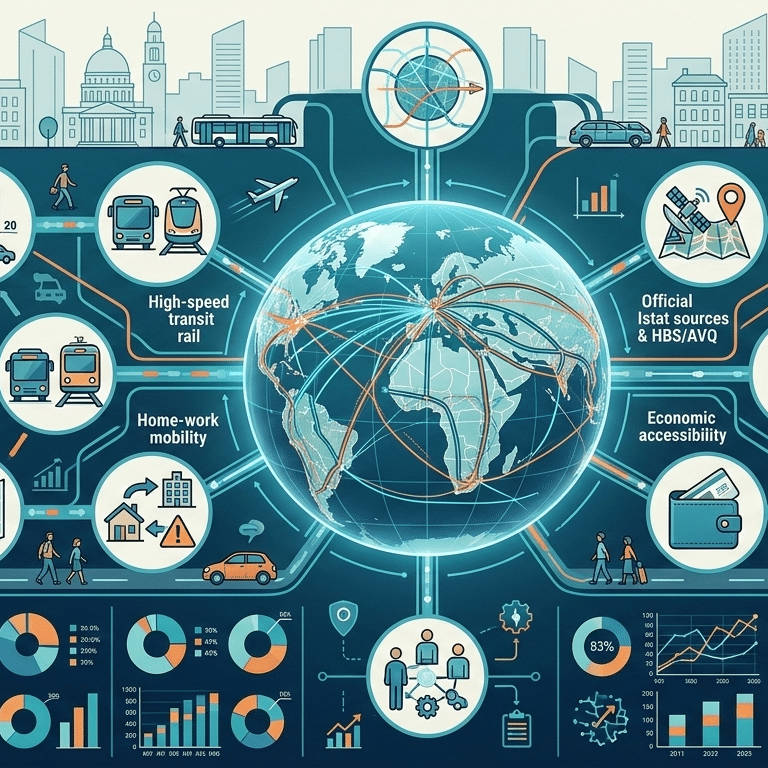
We support organisations in integrating multidimensional information flows, combining statistical rigour with dynamic data.
Use of official data (HBS and AVQ)
- We work with institutional databases such as the Household Budget Survey (HBS) to analyse transport-related expenditure.
- Let's use the survey Aspects of Daily Life (AVQ) to map mobility habits and transport usage.
- We guarantee statistical robustness through the territorial distribution of official movements.
Integration with dynamic data and the web
- We monitor traffic conditions and journey times using data extracted from online platforms and Google Maps.
- We identify risk areas or high accident zones by cross-referencing historical data and current traffic flows.
- Let's analyse the economic and physical accessibility to infrastructure in specific areas of the territory.
3. Results
The integration of these sources allows us to generate high-value technological outputs.
- Advanced Reporting Detailed documentation on the environmental impact of vehicles and critical areas.
- Interactive Dashboards: Visualisation tools that make dynamic data immediately readable.
- Forecasting Models Predictive analytics to assess the effectiveness of new sustainable mobility policies.
4. Impact and operational value
Our approach doesn't stop at data collection; we provide decision-making tools that enable public administrations, transport companies, and planning firms to act with precision.
We value the territory by reducing uncertainty, enabling evidence-based logistics and mobility management oriented towards the real improvement of urban life.